
Harris County Civil Courthouse • Probate Courts 1–5 • Downtown Houston
Overview of Texas Probate Law
Probate is the legal process of settling a deceased person's estate — validating their will (if one exists), identifying and appraising assets, paying debts and taxes, and distributing remaining property to the rightful heirs or beneficiaries.
Texas probate law is governed by the Texas Estates Code, which provides several pathways through probate depending on the estate's size, complexity, and whether the deceased left a valid will. Compared to many states, Texas offers relatively streamlined probate options — particularly independent administration, which allows executors to manage estates with minimal court oversight.
Harris County, as Texas's most populous county, processes thousands of probate cases annually through its five dedicated probate courts. Understanding which type of probate applies to your situation is the first step toward an efficient resolution.
Types of Probate in Texas
Texas offers multiple probate pathways. The right choice depends on whether there's a will, the estate's size, and the level of complexity involved.
Muniment of Title
Fastest option when a valid will exists and there are no unpaid unsecured debts.
6–8 weeks · $2,500–$4,500
Independent Administration
Most common probate in Texas. Executor manages the estate with minimal court oversight.
6–12 months · $4,000–$8,000
Small Estate Affidavit
No will required. For estates under $75,000 (excluding homestead).
30–60 days · $1,500–$3,000
Affidavit of Heirship
Transfers real property without probate. No court hearing required.
2–4 weeks · $1,500–$3,500
Intestate Succession
When someone dies without a will. Court determines heirs through heirship proceeding.
6–12 months · $4,000–$10,000
Will Contest
Challenging a will's validity due to undue influence, fraud, or lack of capacity.
6 months – 2+ years · $5,000–$25,000+
Harris County Probate Courts
Harris County is one of only 12 Texas counties with dedicated statutory probate courts — and with five probate courts, it has more than any other county in the state. Texas has just 24 statutory probate courts statewide, reflecting the specialized nature of probate law. Cases are assigned randomly at the time of filing, and all five courts are located at or near the Harris County Civil Courthouse in downtown Houston.
Visit the Harris County Probate Courts website for official court information, or search probate case records online through the County Clerk's office.
| Court | Judge | Location | Phone | Zoom |
|---|---|---|---|---|
| Court No. 1 | Judge Jerry Simoneaux, Jr. | 201 Caroline, 6th Floor | 832-927-1401 | Available |
| Court No. 2 | Judge Pamela Medina | 201 Caroline, Ste. 680 | 832-927-1402 | Available |
| Court No. 3 | Judge Jason Cox | 201 Caroline, 7th Floor | 832-927-1403 | Available |
| Court No. 4 | Judge James Horwitz | 201 Caroline, 7th Floor | 832-927-1404 | Available |
| Court No. 5 | Judge Fransheneka (Fran) Watson | 1115 Congress, 5th Floor | 832-927-1405 | Available |
All five courts handle the full range of probate matters — wills, heirships, administrations, guardianships, trusts, and related civil litigation. Office hours are generally 8:00 AM to 4:30 PM, Monday through Friday. Each court maintains its own docket schedule and Zoom hearing procedures; check the individual court pages linked above for current policies.
Harris County Public Probate Administrator
When no qualified person is available to serve as executor or administrator of an estate, the Harris County Public Probate Administrator may step in. Under Texas law, the Administrator can only become involved when no other suitable person has been appointed, no family member or close associate is available, and estate assets are at risk of being lost, damaged, or misappropriated. If a qualified person later comes forward, the Administrator will step aside.
Search Probate Court Records Online
Look up any probate case filed in Harris County through the County Clerk's public records portal.
Search Probate Records →Note: Judge names and court details are current as of early 2026. Verify current assignments at the Harris County Probate Courts website.
Getting to the Courthouse
While most uncontested probate hearings can be attended via Zoom, some matters — particularly contested cases like will contests or complex evidentiary hearings — may require an in-person appearance. Here's everything you need to know about visiting the Harris County Probate Courts.
Driving Directions by Freeway
I-45 South (from The Woodlands / Spring)
Take I-45 South toward downtown. Exit at Dallas Street. Turn right on Dallas, then left on Caroline Street. Courthouse is on the right.
I-45 North (from Galveston / League City)
Take I-45 North toward downtown. Exit at Pierce Street / US-59. Merge onto Pierce, then turn right on Caroline Street. Courthouse is ahead on the left.
I-10 East (from Katy / Energy Corridor)
Take I-10 East toward downtown. Exit at Smith Street. Turn right on Smith, then left on Congress Avenue, then right on Caroline Street.
I-10 West (from Baytown / Beaumont)
Take I-10 West toward downtown. Exit at US-59 South / I-69, then exit at Caroline Street. The courthouse is on your right.
Parking
Courthouse Parking Garage
1115 Congress Avenue — closest option, connected to the courthouse complex. Rates vary; arrive early during peak hours.
Surface Lots & Garages
Multiple paid lots along Caroline, Fannin, and Congress within 1–2 blocks. SpotHero and ParkMobile apps can help reserve a spot in advance.
METRORail
The Red Line stops at Preston / Main Street Square, a 5-minute walk to the courthouse. A cost-effective alternative if coming from the Medical Center, Midtown, or NRG area.
Tip: Most uncontested probate hearings last 10–15 minutes. Plan to arrive 15–20 minutes early to clear security and find the courtroom. Kyle Robbins will provide specific courtroom information and entry instructions before your hearing.
Filing Requirements & Procedures
All probate matters in Harris County are filed with the Harris County District Clerk's Office. The general process involves:
- Prepare the application — The specific application depends on the type of probate (e.g., Application to Probate Will as Muniment of Title, Application for Independent Administration, Application for Heirship Determination).
- Attach required documents — Original will (if applicable), certified death certificate, and any supporting affidavits.
- Pay filing fees — Approximately $300–$400 for most probate applications in Harris County.
- Post citation — The court posts public notice for at least 10 days before the hearing (required for most proceedings).
- Attend the hearing — Brief testimony before the assigned probate judge. Most uncontested hearings take 10–15 minutes.
- Receive court orders — Letters Testamentary (with will) or Letters of Administration (without will) grant legal authority to act on behalf of the estate.
All filings in Harris County can be submitted electronically through the eFiling system, and your attorney handles this process entirely.
Remote Hearings & Zoom Appearances
One of the most significant developments in Harris County probate is the widespread availability of remote hearings via Zoom. All five probate courts accommodate video appearances for most uncontested matters, including:
- Muniment of title hearings
- Independent administration appointments
- Heirship determinations
- Inventory approvals
- Routine motions and status conferences
This means families across Houston, across Texas, or even out of state can navigate Harris County probate without ever visiting the courthouse. Kyle Robbins handles all electronic filings and coordinates remote appearances, making the process as convenient as possible regardless of where you're located.
Contested matters (such as will contests) may eventually require in-person appearances, particularly for trials or complex evidentiary hearings.
Timeline Expectations
How long probate takes in Harris County depends primarily on the type of proceeding and whether the case is contested:
These timelines assume uncontested proceedings. Any dispute, missing document, or complication can extend the process. Working with an experienced Harris County probate attorney helps avoid common delays.
Cost Overview
Probate costs in Harris County include attorney fees, court filing fees, and potential additional expenses:
- Court filing fees: $300–$400 for most applications
- Attorney fees: Vary by proceeding type (see ranges above)
- Surety bond: Required in some cases — typically 0.5–1% of estate value annually
- Appraisals: May be needed for real property, business interests, or valuable personal property
- Attorney ad litem: Court-appointed attorney for unknown heirs in intestate cases — fees paid by the estate
- Guardian ad litem: May be required when minor heirs are involved
- Certified copies: $2–$5 per page for court documents needed for asset transfers
Kyle Robbins provides transparent fee quotes before you commit, so there are no surprises. Schedule a free consultation to get a specific estimate for your situation.
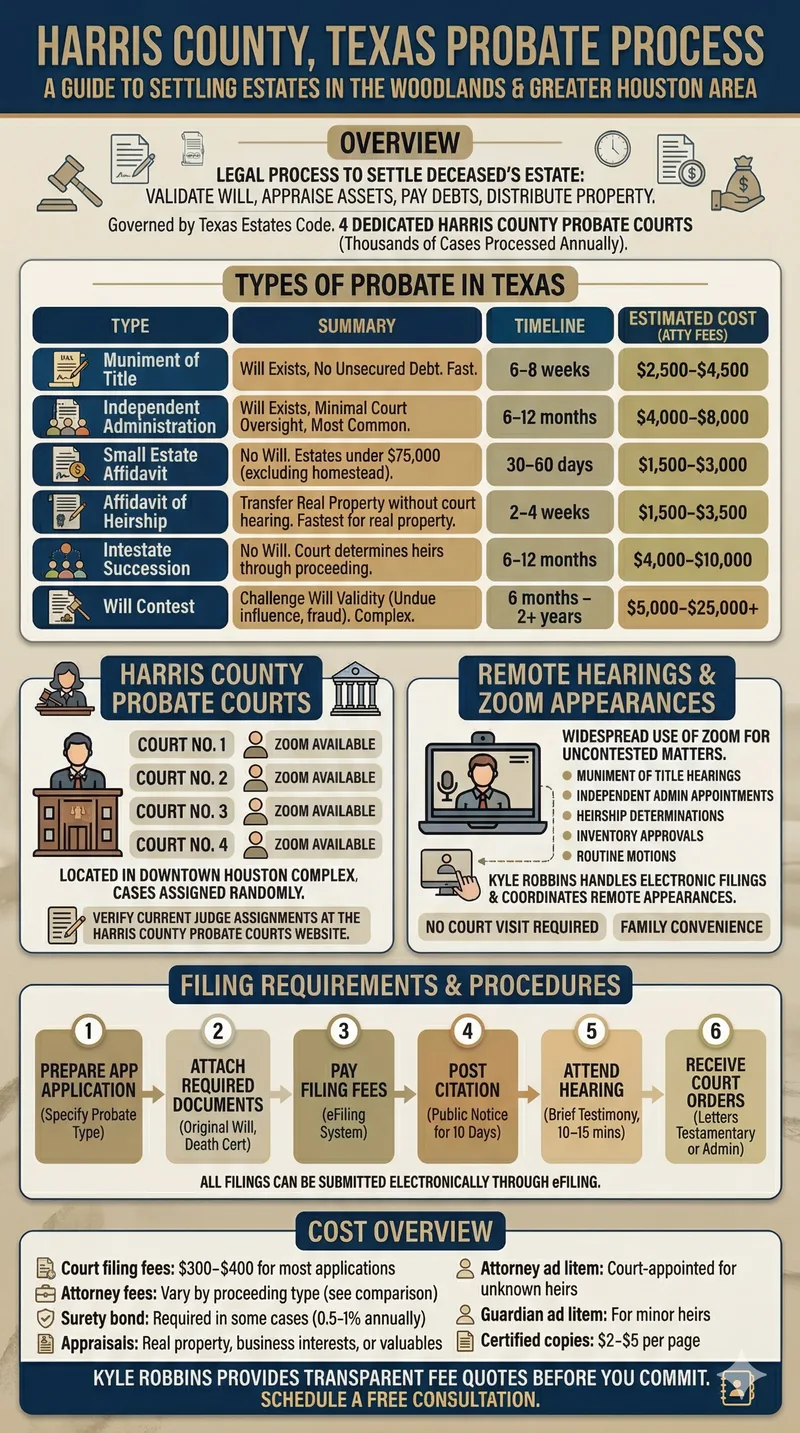
Harris County Probate at a Glance
A visual overview of the entire Harris County probate process — from types of proceedings to filing steps and costs.
Frequently Asked Questions
Attorney Advertising. The information on this page is for general informational purposes and does not constitute legal advice. Every case is unique — contact us for guidance specific to your situation. Past results do not guarantee future outcomes.